REVIEW · CALIFORNIA
Redwood National Park Self-Guided Audio Tour
Book on Viator →Operated by Shaka Guide Apps · Bookable on Viator
Redwoods plus GPS audio equals a stress-free road day. What makes this work is the hands-free flow: GPS-triggered narration and offline maps guide you drive to drive, so you can focus on the redwood canopy and coastal stops instead of your phone.
I also like the value of the pricing. At $13.59 per group (up to 15), it’s one tour per vehicle, with turn-by-turn directions and the freedom to pause and jump between stops. The one consideration: you should download the tour before you’re out there, because the system needs that setup step over Wi‑Fi, even though the route itself runs offline.
In This Review
- Key highlights to know before you go
- Redwood National Park by audio: how this self-guided drive really feels
- Price and logistics: $13.59 per group can be a smart deal
- Setup: download first, then let GPS do the work
- Jedediah Smith Redwoods State Park start: Stout Grove and Titans set the tone
- Stout Grove: a short loop through 300-foot giants
- The Grove of Titans: the elevated walkway that protects the habitat
- Hiouchi Information Center: quick context and a useful local check
- Myrtle Beach swimming hole: quarter-mile descent with pit toilets
- Crescent City beaches: Crescent Beach and the overlook for whales at dusk
- Enderts Beach: tidepools plus a real warning about sneaker waves
- Trees of Mystery: worth it if you want canopy views and a spendy add-on
- Klamath River and the coast: whale-watching from the high ground
- Old Douglas Memorial Bridge site: bear statues and flood memory
- High Bluff Overlook: interpretive signs and coastline drama
- Radar Station B-71: WWII camouflage that used to look like a farm
- Corkscrew Tree and Big Tree Wayside: short walks, huge scale
- Prairie Creek Redwoods State Park and Karl Knapp: choose your loop length
- Elk Meadow Picnic Area and Trillium Falls: a calmer break
- Gold Bluffs Beach and Fern Canyon: the coast turns cinematic
- Lady Bird Johnson Grove and Redwood Creek Overlook: ferns, flowers, and stars
- Thomas H. Kuchel Visitor Center: your last easy win before winding down
- Who should book this Redwood self-guided audio tour
- Should you book it?
- FAQ
- FAQ
- How much is the Redwood National Park self-guided audio tour?
- How long does the tour take?
- Is the audio tour available offline?
- Does the narration play automatically while I drive?
- Where does the tour start, and where does it end?
- Are entrance fees and parking included?
- Is Trees of Mystery included in the tour price?
- Can I cancel for a full refund?
Key highlights to know before you go
- Offline-first navigation with an offline map, so you’re not stuck hunting for service
- One price per vehicle for up to 15 people, which can make a long day feel surprisingly affordable
- Crowd-thinning flexibility since you can skip stops and match your pace
- Towering-redwood stops you can actually time, from Stout Grove to the Grove of Titans walkway
- Coast stops with real safety tips, especially around tidepools and sneaker-wave warnings
- Spotlight on whale-watching viewpoints, like Klamath River Overlook and High Bluff Overlook
Redwood National Park by audio: how this self-guided drive really feels
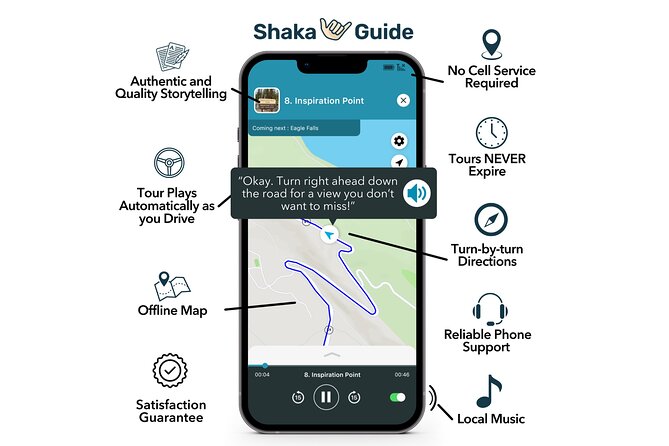
This isn’t a tour where you’re packed into one van, forced to move on someone else’s schedule. It’s a long, scenic day you can steer. The audio plays automatically as you drive, and GPS turn-by-turn keeps you oriented as the road winds through state park pullouts, visitor centers, and beach access points.
You’ll spend the day mixing giants with the coast. On one side you have old-growth redwoods and short walks under massive canopies. On the other you have swimming holes, tidepools, and multiple viewpoints that can be great for whales and sunset. That blend is why this route is so satisfying: you don’t just “see trees.” You also get sea air, beaches, and the kind of dramatic coastline that makes Redwood National and State Parks feel bigger than a typical national park day.
You can also read our reviews of more tours and experiences in California.
Price and logistics: $13.59 per group can be a smart deal
At $13.59 per group (up to 15), this is one of those rare travel products where the cost drops as your party grows. It’s not per person, and that matters on a road trip where you might otherwise pay separate fees just to get basic narration.
A few things to keep your expectations straight:
- Not included: meals, private transportation, entrance fees, and parking fees
- Some attractions can cost extra: Trees of Mystery is explicitly not included
So your budget is likely “mostly free stops plus a possible splurge,” rather than “everything included.”
One more practical note: the route is listed as about 13 to 14 hours. That’s a full day, but it’s also built from shorter stop blocks (5 to 45 minutes most places), which makes it realistic if you’re willing to keep moving and don’t linger too long at each photo spot.
Setup: download first, then let GPS do the work
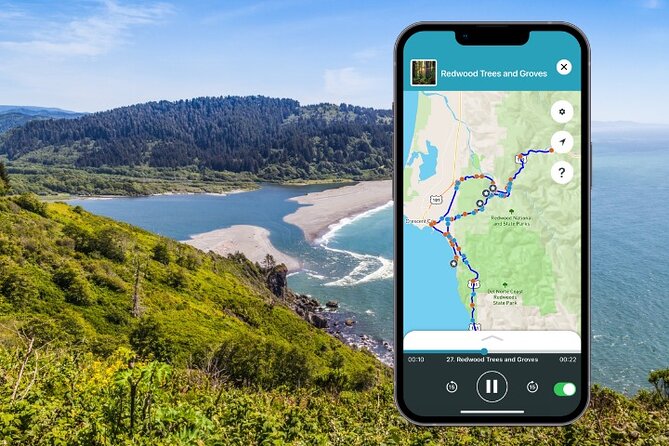
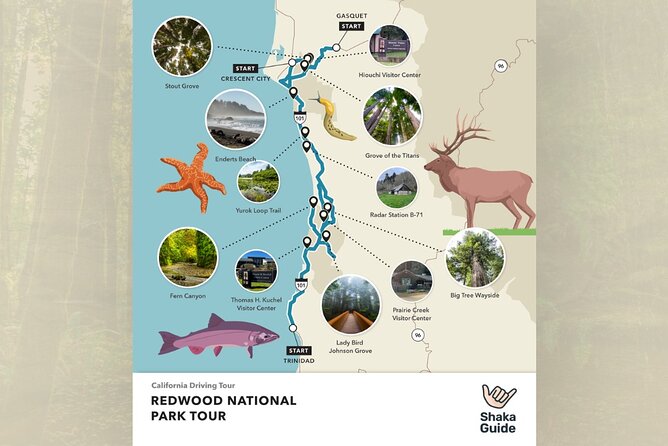
The tour is delivered through the Shaka Guide app. You’ll get confirmation and a redeem code in email, then you launch the tour from your app using GPS. The key step is that you should download the tour using strong Wi‑Fi before you head into areas with spotty service.
Once you’re rolling, you don’t have to babysit the screen. The narration and music are designed to play automatically as you drive, and you’ll get GPS turn-by-turn directions. Offline map access helps when you’re bouncing between trailheads and overlooks.
If you’ve ever had a trip ruined by dead service, this is the style of fix you want: plan once, then focus on the views.
Jedediah Smith Redwoods State Park start: Stout Grove and Titans set the tone
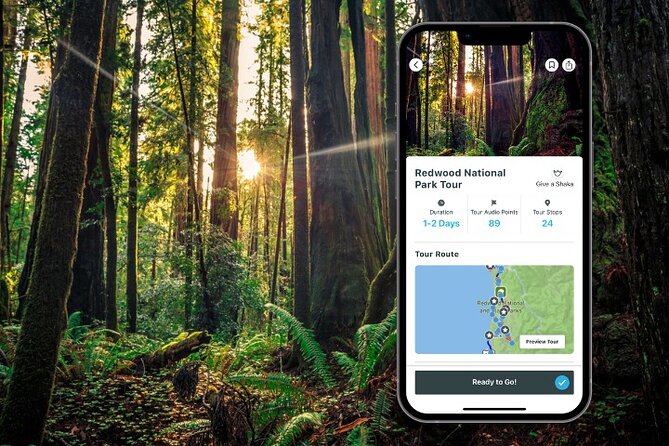
You begin at Jedediah Smith Redwoods State Park, one of the best places in the region to feel the “tall tree” effect right away. This is a park with a lot going on: a visitor center, campgrounds, day-use areas, river beaches along the Smith River, plus major redwood groves like Stout Grove and the Grove of Titans.
Two practical reasons I like this first segment:
- It’s early enough in the day that you’re not already tired of driving.
- It gives you quick wins: short walks with big payoffs.
You’ll also get a sense of how the roads function here. Howland Hill Road winds through redwoods along an old stage-coach route, and narrow, unpaved road access helps connect you to the grove trailheads. That “regional feel” matters, because Redwood country isn’t just one straight road to one view. It’s a web of pullouts and trails.
Stout Grove: a short loop through 300-foot giants
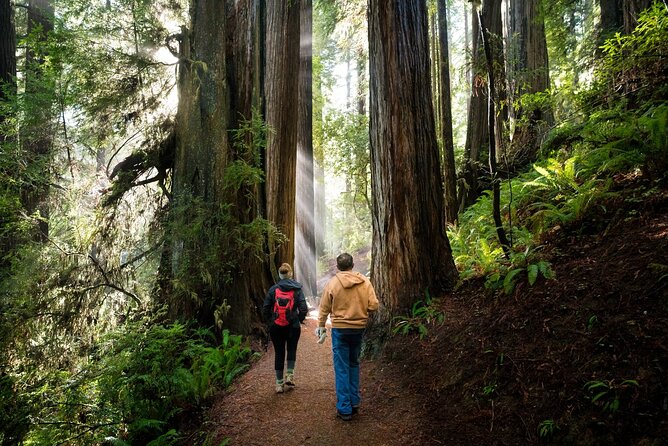
At Stout Grove, you’re in a 44-acre stand of giant redwoods named after Frank Stout, with land donated as a memorial back in 1929. The main hike is an easy half-mile loop, and the trail is designed for visitors who want the redwoods without signing up for an all-day trek.
What I’d do on your first walk:
- Treat it like a reset. Slow down. Read the tree scale with your eyes.
- Stay on the designated trail. This habitat is fragile.
There’s also an optional way to extend toward the Smith River. If you want the day to include water sounds and cooler air, that’s a good choice.
The Grove of Titans: the elevated walkway that protects the habitat
The Grove of Titans is part of the National Tribute Grove area and opened to the public in 2022. Instead of pushing visitors into sensitive ground, the park service built a 1,500-foot elevated walkway through the grove.
That detail changes the experience. You still look up into canopy giants, but you’re doing it from a route designed to reduce impact. If you like your walking to feel safe, smooth, and timed, this is the stop where that pays off.
You’ll spend about 45 minutes here, which is long enough to take photos, soak in the height, and walk the main portion without rushing.
Hiouchi Information Center: quick context and a useful local check
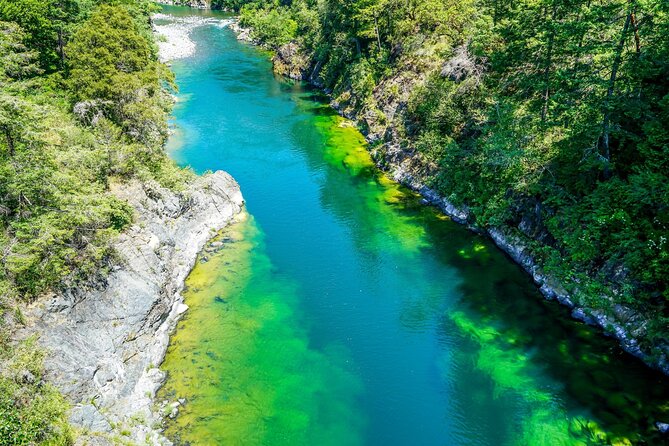
Next you hit the Hiouchi Information Center. It’s a short stop, but it’s a smart one. Exhibits and a park store are nice, and there are restrooms and a picnic area to catch your breath.
The practical value is the ranger check-in opportunity. If you’re thinking about water time on the Smith River, this is where you can ask about guided kayak tours. Even if you don’t book anything, getting local context can help you choose the rest of your day.
Myrtle Beach swimming hole: quarter-mile descent with pit toilets
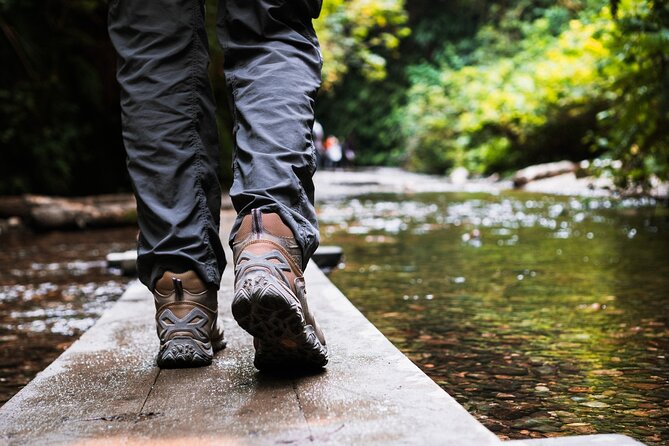
Myrtle Beach is described as one of the best swimming holes along the Smith River, and it’s reached from a parking spot at Highway 199 and South Fork Road. The access path is a short quarter-mile trail but it’s steep, and there are pit toilets halfway down.
Plan this as a “do it if conditions are right” stop:
- It’s ideal for swimming, tubing, fishing, and sunbathing.
- If you’re not set up for water time, treat it like a quick stretch-and-view moment and move on.
If you’re traveling with kids, this is one of the more hands-on places on the route. Bring the usual beach stuff: water shoes if you want them, and a plan for getting back up that steep path.
Crescent City beaches: Crescent Beach and the overlook for whales at dusk
Then you roll into the Crescent City area with Crescent Beach, a three-mile stretch of sand with picnic areas and restrooms. It’s a “stay awhile” kind of stop, even though your scheduled block is about 15 minutes—enough time to get steps in or set up for a longer break if you choose to extend.
A short drive later is Crescent Beach Overlook at the end of Enderts Beach Road. This one is more about viewing than walking: you get wide views of Crescent Beach, Crescent City, and Battery Point Lighthouse. It’s also labeled as a good spot for whales and a great place to return for sunset.
In practice, this is where your timing matters. If you’re driving the whole route straight through, consider aligning your sunset interest with your energy level.
Enderts Beach: tidepools plus a real warning about sneaker waves
At Enderts Beach, you park by the trailhead and walk down a moderate 1.5-mile round trip route. You end with a short scramble down a big boulder, and you’re dealing with tide conditions.
This is one of the stops where the route’s advice matters most:
- At low tide, you can get close to colorful starfish and anemones in the tidepools.
- If the tide’s up, you’ll want to save this beach for another time.
- Watch for rising tide and dangerous sneaker waves.
My practical recommendation: treat Enderts as a “tideplan” stop. If you can’t confidently judge timing, it’s better to shorten your overall beach time and focus on the overlooks and visitor centers that don’t depend on the ocean’s schedule.
Trees of Mystery: worth it if you want canopy views and a spendy add-on
Trees of Mystery sits right off Hwy 101, so it’s easy to slot in without extra driving. It mixes interpretive trails, a museum of artifacts, skybridges, and even a gondola ride that takes you above the treetops.
Your time block is about 2 hours, and the big note is that the attraction is not included in your audio tour price. Still, it’s called out as a recommended splurge if you have the budget, mainly because it gives a different perspective than the short forest walks.
If your party loves viewpoints and hands-on exhibits, this is the one “pay once, then enjoy more” stop. If you prefer to keep the day mostly free, you can treat it as optional and lean harder into the Redwoods State Park trails.
Klamath River and the coast: whale-watching from the high ground
As you move along the coast, your route includes the Klamath River Overlook. It’s about 600 feet above sea level, and there’s also a half-mile hike down to a second viewpoint for a closer perspective.
This is another whale-watching-friendly stop, and sunset is a theme at multiple overlooks. If you want one simple strategy: don’t rely on one viewpoint. Hit two, even if you only spend a few minutes at each. Conditions change fast.
Next you also visit the Yurok Country Visitor Center in Klamath, which is a tribal interpretive center where you can learn about Yurok history and culture and pick up souvenirs. Even with a short time block, it’s a useful “pause” from driving and hiking.
Old Douglas Memorial Bridge site: bear statues and flood memory
At the Old Douglas Memorial Bridge site, you’ll see what’s left of a bridge built in 1926, destroyed in the Christmas Flood of 1964. What remains are the iconic bear statues at each end.
Across Highway 101, the new bridge includes replicas of these original grizzly bear statues. This stop is brief, but it adds a layer beyond nature-only sightseeing: you’re looking at how coast communities rebuild and how landmarks change after major events.
High Bluff Overlook: interpretive signs and coastline drama
On Coastal Drive, High Bluff Overlook gives you another wide, coast-south view. There are interpretive signs, picnic tables, grills, pit toilets, and a short trail that leads to even more views below.
This is a good stop when you want less walking and more “big picture” sightseeing. If whales are on your wishlist, this is part of that repeated theme on the route: the ocean is best when you can watch from height.
Radar Station B-71: WWII camouflage that used to look like a farm
A very different kind of stop comes next at Radar Station B-71. During WWII, the Coast Guard built the station near Klamath and instead of camouflaging it in a typical way, they disguised the radar installation as a farmhouse and barn.
The idea is sneaky in a practical way: it’s hiding in plain sight. It also connects to a network of coastal stations stretching from Mexico to the Canadian border, so it’s a reminder that this coast isn’t just scenic—it’s strategic.
Corkscrew Tree and Big Tree Wayside: short walks, huge scale
Then you turn inland toward redwood roadways with a couple of quick-hit landmarks.
Corkscrew Tree is described as a fairy ring or cathedral tree: four redwoods grew from one parent tree and twisted around each other into one sinuous trunk. It’s a 15-minute stop, but it’s the kind of photo spot that makes your group smile because it looks “wrong” in the best way.
Not far away is Big Tree Wayside off the Newton B. Drury Parkway. This is an old-growth giant estimated at around 1500 years old and over 300 feet tall. There’s a short path to the tree plus interpretive signs and restrooms nearby, which makes it easy to include even if you’re saving energy for later trails.
Prairie Creek Redwoods State Park and Karl Knapp: choose your loop length
Next is Prairie Creek Redwoods State Park with the Prairie Creek Visitor Center. This center has park information, exhibits, a bookstore, camp sites, restrooms, and a picnic area. There are multiple trails that start near the center, including an accessible Revelation Trail and bigger popular options like Karl Knapp, Foothills, and Cathedral Trees Trails.
If you want one trail decision that ties multiple stops together, that’s where Karl Knapp Trail comes in. The route is a 2- to 3-mile loop that follows Prairie Creek north, includes a spur to the Big Tree area, then returns via Foothill and Cathedral Trees options depending on how long you want to walk.
This part is where pacing matters. If you’re feeling good, take the longer loop. If you’re tired, you can keep it shorter and still hit the “why you came” moments.
Elk Meadow Picnic Area and Trillium Falls: a calmer break
At Elk Meadow Picnic Area, you get restrooms, picnic tables, and trails. The route notes you might spot elk in the fields, and the key instruction is distance: keep at least 50 yards away.
Trillium Falls is an easy add-on from here: about one mile round trip to a small waterfall through old-growth forest. If you want a reset without a big commitment, this is it.
Gold Bluffs Beach and Fern Canyon: the coast turns cinematic
Gold Bluffs Beach is named for gold found in the sand, discovered in 1850. Mining efforts didn’t work well because the gold was so fine it was extremely costly and time-consuming to separate from the sand. It’s a fun “how did this place get its name” moment that feels grounded in real attempts, not a myth.
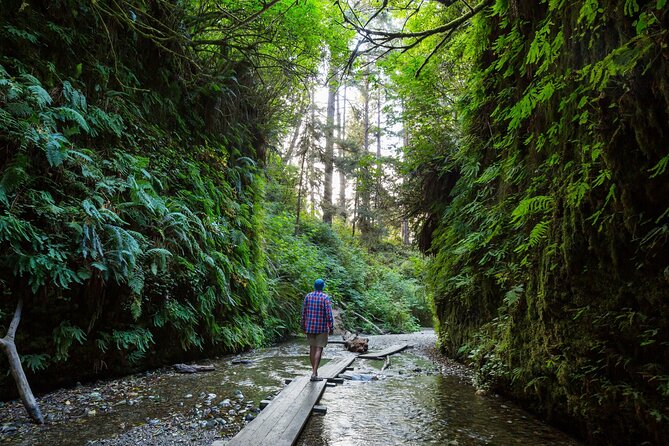
Then you have Fern Canyon Trail, about a mile either direction. It’s described as primeval-feeling, and scenes from Jurassic Park: The Lost World were filmed here. You can hike through and return, or do a loop, so it’s flexible based on your time and the mood of your group.
Lady Bird Johnson Grove and Redwood Creek Overlook: ferns, flowers, and stars
At Lady Bird Johnson Grove, expect a family-friendly loop trail through forest with ferns and colorful rhododendrons, plus taller trees. The grove is named for Lady Bird Johnson, with specific links to her support for creating national parks that helped lead to Redwood National Park’s creation in 1968. The dedication in 1969 by President Nixon is included in the tour notes.
Then you continue to Redwood Creek Overlook in the Bald Hills. This sits at 2,100 feet (640 meters) above sea level, with sweeping views of redwood forests and the Pacific in the distance. It’s framed as a strong sunset and star-watching spot. Even if you only have part of your time block, high-ground overlooks are where you’ll remember the scale of the whole region.
Thomas H. Kuchel Visitor Center: your last easy win before winding down
You finish with Thomas H. Kuchel Visitor Center, the main visitor center for Redwood National Park. It has exhibits, park information, a park store, and restrooms. Trails behind the center lead to the beach, and it’s also a whale-spotting and sunset watch recommendation.
Your tour ends back at the starting meeting point, so you’re not stuck figuring out how to “wrap” the day. With a drive like this, that matters.
Who should book this Redwood self-guided audio tour
This works best if you:
- Want a road-trip style day with control over timing
- Prefer learning from GPS-triggered narration instead of a live group guide
- Have a mixed crew (walkers, swimmers, and viewpoint seekers) and want everyone to get their moments
- Like the idea of using an offline map so service doesn’t run your schedule
It’s also a good fit for groups up to 15 since pricing is per vehicle. And because most travelers can participate and service animals are allowed, it’s built to be broadly usable.
Should you book it?
Yes, if your dream Redwood day includes both giants and coastline, and you want freedom to shape the schedule without losing your way. The pricing is one of the main reasons: $13.59 per group for a long, detailed route can feel like a bargain once you compare it to per-person tours.
The main reason not to book is simple: if you hate planning and you show up without downloading ahead of time, you may feel stuck during setup. Treat downloading as a non-negotiable step, then enjoy the rest offline.
FAQ
FAQ
How much is the Redwood National Park self-guided audio tour?
It costs $13.59 per group, up to 15 people.
How long does the tour take?
The duration is listed as about 13 to 14 hours.
Is the audio tour available offline?
Yes. You get an offline map and the tour is designed to work without continuous wifi or data.
Does the narration play automatically while I drive?
Yes. Audio narration plays automatically as you drive, with GPS-triggered directions.
Where does the tour start, and where does it end?
The activity ends back at the meeting point. There’s also an additional starting point available in Trinidad, CA.
Are entrance fees and parking included?
No. Entrance fees and parking fees are not included.
Is Trees of Mystery included in the tour price?
No. Admission for Trees of Mystery is listed as not included.
Can I cancel for a full refund?
You can cancel for free up to 24 hours in advance of the experience start time for a full refund. If you cancel less than 24 hours before, the amount paid is not refunded.