REVIEW · MOAB
Full-Day Audio Driving Tour of Arches National Park
Book on Viator →Operated by Shaka Guide Apps · Bookable on Viator
Arches is best when you control the pace. This self-guided drive uses GPS turn-by-turn directions and offline maps, so you can explore remote viewpoints without fighting spotty service. It’s a simple way to hit the park’s most famous rock formations in one long, satisfying day.
I especially like the hands-free audio narration that plays as you drive, so you don’t need to stop and read. I also like the value model: it’s priced per group (up to 15), with lifetime access to the app and the offline data.
The main catch is practical: your phone battery matters. If you don’t download ahead and keep power in the car, the tour can lose its magic.
In This Review
- Key highlights at a glance
- Why this Arches audio drive fits this park’s style
- Price and what you actually get for $12.79 per group
- Offline maps and GPS directions: the real value in remote Utah
- How long to plan (and how to pace the 19 stops)
- Your Arches route, stop by stop: what to expect and what’s worth more time
- Start at Arches National Park entry and the main park zone
- Visitor Center breaks: water, snacks, restrooms, and a quick reset
- Geological viewpoints that explain the park’s big forces
- “A classic photo moment” stops with built-in short viewing time
- Stops that feel playful: dunes, petrified sand, and horizontal arches
- Windows Road and nearby free areas: where you start stacking famous arches
- High view energy with big sightlines
- Delicate Arch: the main event, plus two easier ways to see it
- Salt Valley and Fiery Furnace: the places for curiosity (and permits)
- Quick arch walking: Sand Dune Arch and Skyline Arch
- The biggest walk on the route: Devils Garden and the Landscape Arch payoff
- Food, water, and practical comfort for a long Arches day
- Who should book this audio driving tour
- Should you book this Arches audio driving tour?
- FAQ
- FAQ
- What is the price for this Arches audio driving tour?
- How long should I plan for the full experience?
- Do I need a rental car to do this tour?
- Is park admission included in the tour price?
- Does the tour work with offline maps and no cell service?
- Is the narration in English?
- Can I pick and choose stops instead of doing everything?
- Do the tours expire?
- Is the Fiery Furnace hike included?
- Can I cancel and get a refund?
Key highlights at a glance
- Offline-first route: GPS directions and maps work without Wi-Fi or cell service.
- Hands-free audio: stories, travel tips, and music play automatically as you drive.
- Pick-your-stops flexibility: start, pause, and resume, and skip what you don’t want.
- Built for a full day: a route paced around ~20 minutes per stop, plus time at the major areas.
- Arches essentials included: Delicate Arch viewpoints, Windows Road, Garden of Eden, Devils Garden, and more.
- Good value per vehicle: one tour per group up to 15 people.
Why this Arches audio drive fits this park’s style
Arches National Park rewards slow looking. You can spend 10 minutes spotting details in the rock, then linger on the view like you’re waiting for the light to finish its job. This tour is made for that kind of day.
Instead of following a rigid group schedule, you’re driving the route and the app cues you at each stop. The result is part guided, part free-form. One moment you’re learning why the rocks look the way they do. The next moment you’re deciding how long you want to stand there and let it sink in.
The other big advantage is the offline setup. Much of Arches sits in a place where cell service can be unpredictable. With offline maps and offline GPS, you’re not stuck hoping your signal holds.
You can also read our reviews of more tours and experiences in Moab.



Price and what you actually get for $12.79 per group
This one is priced at $12.79 per group, up to 15 people, which changes the math fast. If you’re traveling with a family, a couple of friends, or a small group in one vehicle, the cost per person drops dramatically.
For that price, you’re not just getting a voice-over. You also get:
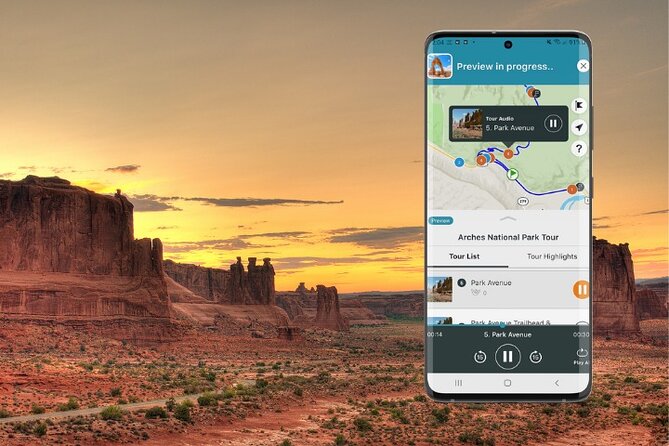
- turn-by-turn GPS directions
- an offline map you can use with no Wi-Fi/data
- audio narration with stories, travel tips, and music
- the ability to pause/resume and choose which stops to do
- activity and restaurant recommendations inside the app
- lifetime access (the tour doesn’t expire)
Also note what you’re not paying for: park entry fees. The app handles the guidance. You handle the gate.
Offline maps and GPS directions: the real value in remote Utah
In Arches, the “where am I?” problem can eat time. This tour is built around solving that. Your phone becomes a navigation brain: it gives turn-by-turn driving directions and it keeps working when service fades.
Here’s the practical way to use that advantage:
- Download your tour before you lose internet connection. If you wait until you’re deep in the park, you can end up with a stalled experience.
- Plan for power. Audio plus GPS can drain a phone faster than you expect, especially on a day with lots of camera time.
- If your phone is picky about GPS accuracy, a car mount helps. You want the screen easy to check when you’re parked, even if the audio is running hands-free.
If you want a stress-free day, this is exactly the kind of “offline-first” tool that makes the park feel simpler.
How long to plan (and how to pace the 19 stops)
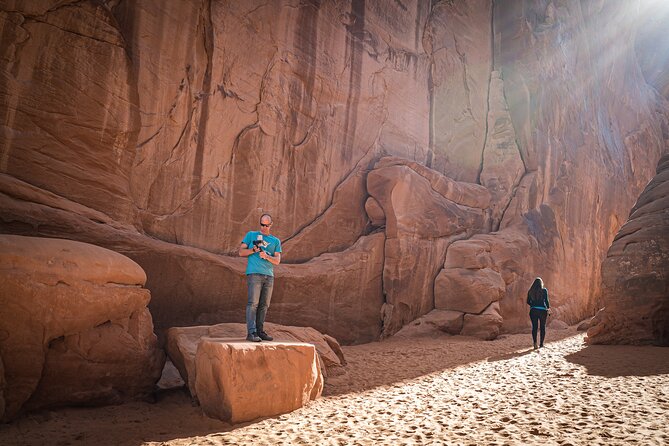
The advertised window is about 6 to 8 hours. That’s a solid estimate if you treat each stop as about 20 minutes of viewing time, then allow extra time for the areas where you’ll naturally linger.
A few itinerary elements affect your pacing:
- Some areas are viewpoint-style with short or optional walking.
- Some involve real walking (like Devils Garden’s trail options).
- Some are permit-based (Fiery Furnace).
My rule of thumb for a day like this: don’t plan to sprint. You’ll enjoy Arches more if you accept that the “20 minutes” per stop is the minimum. The rocks are the show, and you’ll want time to look upward.
Your Arches route, stop by stop: what to expect and what’s worth more time






Start at Arches National Park entry and the main park zone
Stop 1: Arches National Park (about 2 hours; admission ticket not included).
This is where you establish your mental map. Arches is big, and the formations repeat some visual themes—so early orientation helps. Use this time to get your bearings, grab water if you need it, and settle in before you start your rhythm.
Visitor Center breaks: water, snacks, restrooms, and a quick reset
Stop 2: Arches Visitor Center (about 20 minutes; admission not included).
This is one of the most useful stops in the whole day because it covers basics: water, snacks, and restrooms. The park’s food options are limited, and the app’s route is designed around that reality. If you want a smoother day, top off here so you’re not scrambling later.
Geological viewpoints that explain the park’s big forces
Stop 3: Moab Fault Overlook (about 20 minutes; admission not included).
This viewpoint is about pressure and separation—what happened to split one side of the canyon area from the other. If you like science stories, this one gives you a reason behind the shapes.
Stop 5: La Sal Mountains Viewpoint (about 20 minutes; admission not included).
La Sal means salt in Spanish. The name connects to 1776 Spanish explorers who thought the snowy peaks looked like piles of salt. It’s a small history nugget that adds context while you look at the big horizon.
“A classic photo moment” stops with built-in short viewing time
Stop 4: Park Avenue Trail (about 20 minutes; admission not included).
City folks compare this feeling to standing near New York skyscrapers. It’s that canyon-like, towering-wall perspective that makes it work even for people who don’t want a long hike.
Stop 6: Courthouse Towers (about 20 minutes; admission not included).
Here you’ll see named formations like Three Gossips, The Organ, and Sheep Rock. These names matter because they help you remember what you saw, not just that you saw tall rocks.
Stop 8: Balanced Rock Trail (about 20 minutes; admission not included).
Balanced Rock is over 120 feet tall—about 11 stories. The famous feature is the ball-like form perched on the spire below. This is a “stand and stare” stop. It’s hard to believe it’s that stable-looking.
Stops that feel playful: dunes, petrified sand, and horizontal arches
Stop 7: Petrified Dunes Viewpoint (about 20 minutes; admission not included).
You might first think it’s just lumpy rock, but it’s actually old sand dunes—then petrified, meaning the sand solidified into rock about 200 million years ago. It’s a great stop if you like the idea that Arches holds time capsules.
Stop 11: Pothole Arch (about 20 minutes; admission not included).
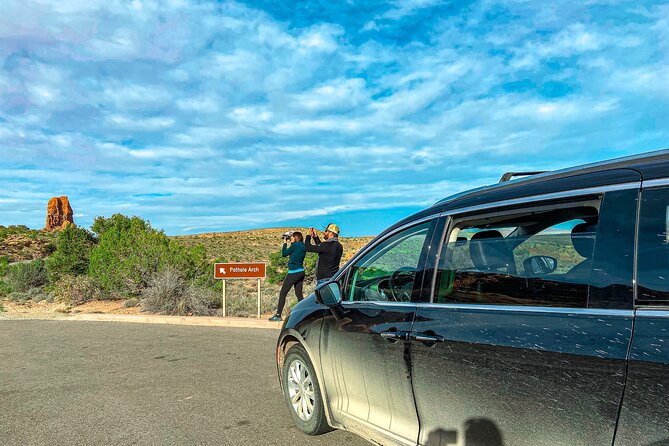
Most arches you’ll see are vertical. Pothole Arch is horizontal, so the shape and how light hits it can feel different. It’s a good counterpoint to the more famous upright icons.
Windows Road and nearby free areas: where you start stacking famous arches
Stop 9: The Windows Road (about 20 minutes; admission ticket free).
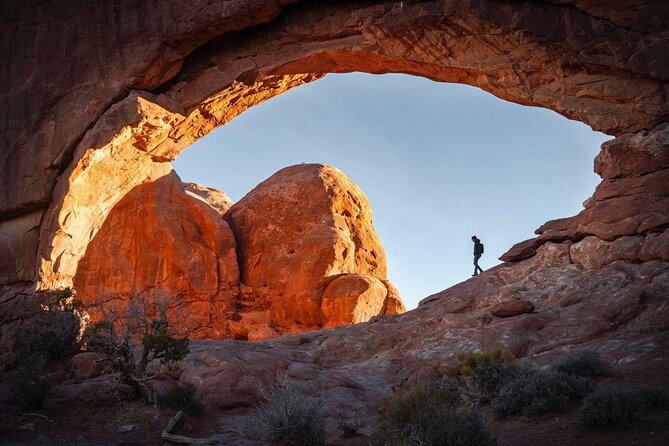
This area has more than 30 arches, including The Windows, Turret Arch, and Double Arch. Double Arch is the one people often recognize from the Indiana Jones and the Last Crusade opening scenes.
Stop 10: Garden of Eden (about 20 minutes; admission ticket free).
This is an easy place to spend time because there’s open terrain with fins, windows, and miniature arches. There’s no designated trail, so watch your step—especially because biocrust can be fragile. The app also points out that Owl Rock is a short walk from the parking lot, which helps you pick a simple add-on.
High view energy with big sightlines
Stop 12: Panorama Point (about 20 minutes; admission ticket free).
From high up, you can see for miles. The app frames key directions: north toward Devil’s Garden and the Fiery Furnace area, and south toward Elephant Butte, the park’s highest point at 5,600 feet.
Delicate Arch: the main event, plus two easier ways to see it
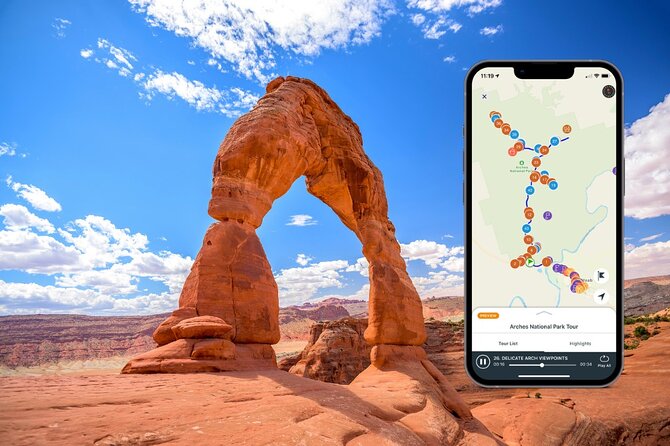
Stop 13: Delicate Arch (about 20 minutes; admission not included).
This is the most famous arch in Arches and it’s on the Utah state license plate. It’s not the tallest formation in the park, but it has that special charm that makes people plan their trip around it.
Stop 14: Delicate Arch Viewpoint (about 20 minutes; admission ticket free).
If you don’t want the full hike, you still get options:
- A lower viewpoint with just about a 100-foot walk from the parking area
- An upper viewpoint about a half-mile round trip
This stop is a good time-saver, especially if you’re driving with limited daylight or you want to keep your energy for later.
Salt Valley and Fiery Furnace: the places for curiosity (and permits)
Stop 15: Salt Valley Overlook (about 20 minutes; admission not included).
It was once called a paradox formation because early geologists struggled to explain how it formed. If you like “how could that happen?” questions, this works.
Stop 16: Fiery Furnace (about 20 minutes; admission not included).
Fiery Furnace earns its name because the rocks can glow like they’re on fire when the sun hits at the right angle. The real kicker: there’s a permit-only hike, with limited permits reserved online. The tour route skips recommending the hike on this drive since it’s difficult, but you can plan it separately if you’re set on going.
Quick arch walking: Sand Dune Arch and Skyline Arch
Stop 17: Sand Dune Arch Trail (about 20 minutes; admission not included).
This gives you a short walk to Sand Dune Arch, including a sand pit that works well for kids. The option expands if you want more: there’s a two-mile hike to Broken Arch, and a rough road that leads further toward Tower Arch.
Stop 18: Skyline Arch (about 20 minutes; admission not included).
Skyline Arch frames the sky over the horizon. No long hike is required to see it, though a short walk—about 10 minutes on foot—can get you closer.
The biggest walk on the route: Devils Garden and the Landscape Arch payoff
Stop 19: Devils Garden (about 20 minutes; admission ticket free).
This is where you feel like you’re finally in the arch maze for real. The route suggests a short hike of about two miles, and it’s well worth it. You’ll also find picnic tables and a restroom if you want to pause and reset.
The headliner is Landscape Arch, the longest arch in North America. Even if you only do part of the trail, it’s the kind of formation that changes how you see everything else.
Food, water, and practical comfort for a long Arches day

Plan like you’re in a desert-adjacent environment:
- Start with basics at the Visitor Center, where you can get water, snacks, and restrooms.
- The app’s route notes that there’s no other place to buy food inside the park, and the only other drinking water is at the far end of the road at Devil’s Garden.
- Bring what you need because the drive is long and parking stops can add time.
For comfort, also think about battery and movement. You might want a car charger or power bank because GPS + audio + camera use can drain phones quicker than you expect.
Who should book this audio driving tour
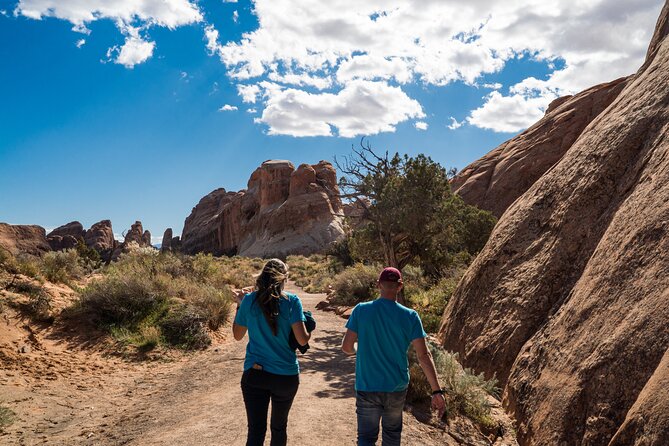
This is a strong match if you want:
- flexibility to stop and go at your pace
- a low-cost guided structure without paying per person for a ranger-led bus style tour
- a way to cover a lot of Arches icons in one day without memorizing routes
It’s also great for families because many stops are viewpoint-based with short walks. For people who want a very active day with multiple permits or long hikes, you may still want to plan the hikes separately—Fiery Furnace in particular is permit-driven.
And if you don’t like using your phone for navigation, or you hate being responsible for power and downloads, this might feel like work instead of fun.
Should you book this Arches audio driving tour?

Yes—if you want a self-guided day that hits Arches’ biggest arch highlights while keeping you out of the stress of figuring out timing and directions. The offline map and GPS are the main reason it’s worth considering, especially for a park that can leave you with weak signal.
Book it if:
- you’re driving your own vehicle
- you’re okay topping off water and snacks yourself
- you’ll download the tour before you lose internet access
- you want flexibility more than you want a live guide
Skip it if:
- your phone battery is always shaky and you can’t charge in the car
- you only want formal guided hikes and don’t want to handle permits like Fiery Furnace
- you’re hoping admission fees are included (they aren’t)
FAQ
FAQ
What is the price for this Arches audio driving tour?
It costs $12.79 per group, for up to 15 people.
How long should I plan for the full experience?
Expect about 6 to 8 hours.
Do I need a rental car to do this tour?
Rental car is not included, so you’ll need your own vehicle or a rental.
Is park admission included in the tour price?
Entry fees are not included. Some stops on the route are marked as free, but the park admission situation is separate from the app.
Does the tour work with offline maps and no cell service?
Yes. The app includes an offline map, and GPS works completely offline with no Wi-Fi or data needed.
Is the narration in English?
Yes, the tour is offered in English.
Can I pick and choose stops instead of doing everything?
Yes. You can explore at your own pace and choose the stops you want to do.
Do the tours expire?
No. Tours never expire, and you get lifetime access to the app and data.
Is the Fiery Furnace hike included?
The Fiery Furnace hike is permit-only and requires a reservation reserved online. The tour route does not recommend the hike on this drive due to difficulty.
Can I cancel and get a refund?
You can cancel up to 24 hours in advance for a full refund.