
REVIEW · OREGON
Crater Lake National Park Self-Guided Audio Tour
Book on Viator →Operated by Shaka Guide Apps · Bookable on Viator
Crater Lake gets easier with a GPS narrator. This self-guided route turns a long rim drive into a story-filled day with automatic audio and offline maps that keep you moving even when cell service disappears. I also love the “one vehicle, one booking” value for groups and how you can pause, walk, and skip stops without feeling rushed.
My main caution: the narration can get very direction-heavy, and if roads force you to backtrack (like during seasonal closures), you may hear repeated turn prompts and miss some story points you hoped to catch later. Still, it’s a solid way to add context to big views without hiring a guide or buying per-person extras.
In This Review
- Key highlights you’ll actually use
- How GPS Audio Changes the Crater Lake Experience
- Starting from Fort Klamath: Build a 7–8 Hour Rim Day
- Mazama Village Campground: Warm Up the Day at the South Entrance
- Annie Creek Canyon Overlook: Fossil Spires Made During the Mazama Eruption
- Godfrey Glen Nature Trail: Easy Loop, Great Old-Growth Feel
- Steel Information Center (William Gladstone Steel): A Modern Visitor Hub in a Historic Building
- Rim Village: The Center of Gravity for Lake Views and Quick Trails
- Crater Lake Lodge: Built in 1915, Still Feels Like the Main Event
- Rim Visitor Center and the Kiser Studio: Maps, Books, and a Passport Stamp
- Discovery Point Trailhead: Your Rim-to-Wizard Island Payoff Walk
- Sinnott Memorial Overlook: The Cliffside Exhibits Add a Personal Touch
- Watchman Overlook and Watchman Peak: Pick One View Style
- Merriam Point and Steel Bay: Two More “Look Here” Moments
- Cleetwood Cove Trail: The Lake-Level Stop (And the Switchbacks)
- Skell Head, Cloudcap, and Phantom Ship: The “How Could This Be Real?” Cluster
- Plaikni Falls and Pinnacles: Forest, Water, and Fossil Volcano Plumbing
- Sun Notch, Vidae Falls, and Castle Crest Wildflower Trail: Finish with Easy Variety
- Price and Value: $15.19 Per Group, Not Per Person
- Who This Self-Guided Audio Tour Fits Best
- Should You Book This Crater Lake Audio Tour?
- FAQ
- What is the price for the Crater Lake National Park self-guided audio tour?
- How long does the Crater Lake audio tour take?
- What’s included in the tour?
- Do I need internet or cell service to use the tour?
- Where does the tour start and end?
- Can I cancel and get a full refund?
Key highlights you’ll actually use
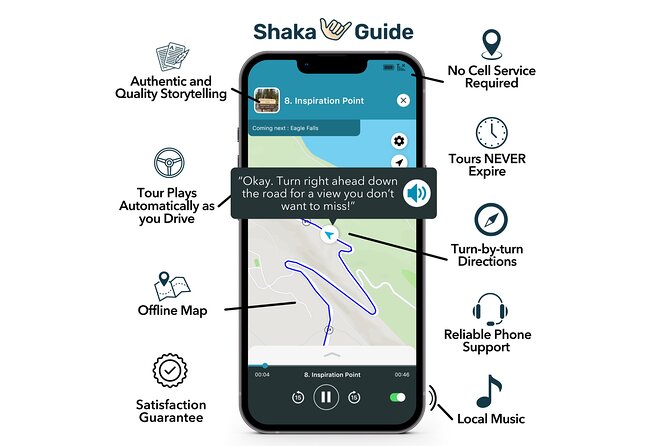
- GPS-activated narration plays as you drive, so the park story follows the view
- Offline map + offline audio means fewer headaches in remote areas
- A group deal: one price per vehicle (up to 15 people), not per person
- Real rim-walk options: Discovery Point, Watchman, Cleetwood Cove, and more
- Good geology storytelling: Mount Mazama, pinnacles, fumaroles, and Phantom Ship explained
How GPS Audio Changes the Crater Lake Experience
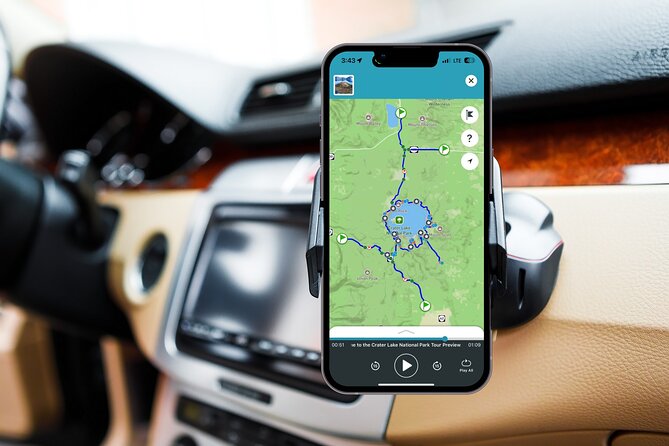
Crater Lake can feel like a string of epic pull-offs. With this tour, those pull-offs come with a running explanation—so you’re not just taking photos, you’re learning what you’re looking at while you’re looking at it. The audio includes stories, travel tips, and music, and it’s designed to play automatically as your vehicle approaches the next point.
What I like most is that it doesn’t force you into one tight schedule. You’re in control. You can stop for a quick overlook, take a longer hike, or skip ahead if your group is tired or the weather changes fast.
The tour also runs on GPS turn-by-turn directions and an offline map. That matters at Crater Lake because you’re often driving through stretches where phone service is spotty at best.
Starting from Fort Klamath: Build a 7–8 Hour Rim Day
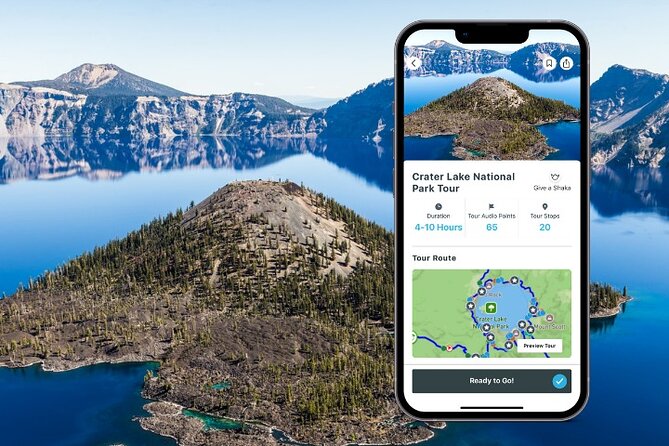
This experience starts and ends back at Fort Klamath, Oregon. You can also start from a few other listed meeting areas, depending on what’s easiest for your drive. Plan on about 7 to 8 hours total if you’re doing several hikes and not just photo stops.
The route is packed with stops, but they’re not all equal. Some are pure “park your car and look” moments—think 5 to 15 minutes. Others are real hikes, like the rim loop at Discovery Point or the lake-level climb to Cleetwood Cove.
My practical suggestion: decide early what your group wants—views only, light walks, or a full hit list. The tour lets you match the day to your energy, but your time still has limits once you start adding trail time.
Mazama Village Campground: Warm Up the Day at the South Entrance
Your first stop is Mazama Village Campground & Cabins near the south entrance. It’s a useful launch point because you get more than just parking: there’s an Annie Creek Restaurant and Gift Shop, a camp store with groceries/snacks/sundries, and public restrooms. If you need trail info for the nearby Annie Creek Trail, the camper store is where you should ask.
After you settle in, you’ll immediately get pulled into the park’s volcanic story. That’s the key here: this tour doesn’t wait until the “big moments” to start making meaning.
Annie Creek Canyon Overlook: Fossil Spires Made During the Mazama Eruption
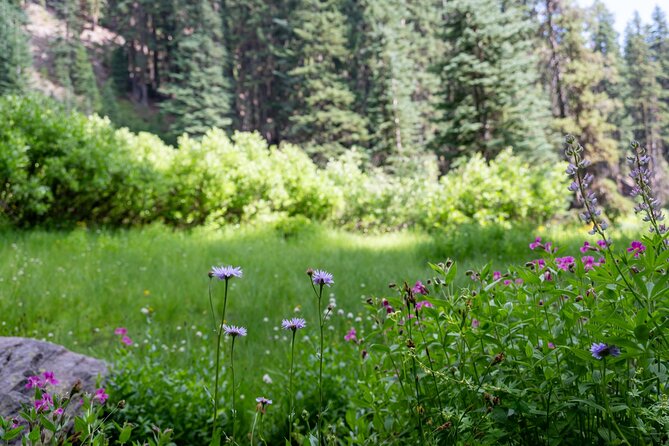
Next is Annie Creek Canyon, a short roadside stop with a view of volcanic pinnacles. These are described as towering ash-and-pumice spires—formed during the catastrophic eruption of Mount Mazama.
Expect a quick hit here: about 5 minutes to pull over, look, and absorb the explanation. This is one of those spots where the audio helps your brain connect what you see (odd rock towers) to how it got there (volcanic history).
Godfrey Glen Nature Trail: Easy Loop, Great Old-Growth Feel
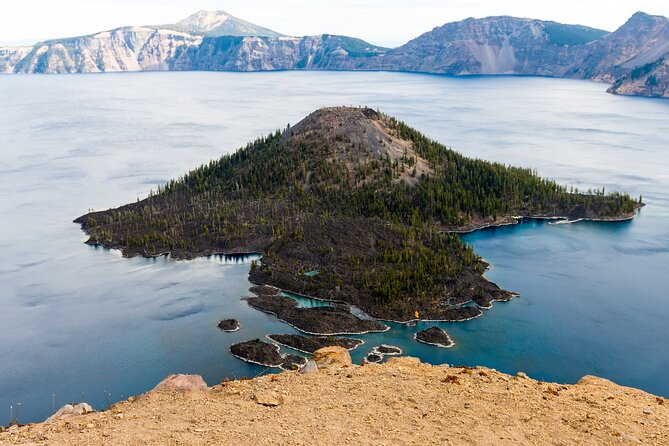
Then you get an easy walk at Godfrey Glen Nature Trail. It’s a one-mile loop, and it’s one of the park’s accessible and pet-friendly trails. The path runs along the edge of a steep canyon and moves through shady old-growth forest, with views of those strange needle-like towers called pinnacles.
This is the kind of hike that works for mixed groups: not too long, not too technical, and still rewarding. Budget about 30 minutes, which gives you time to walk, listen, and stop if you’re spotting birds or just enjoying the shade.
Steel Information Center (William Gladstone Steel): A Modern Visitor Hub in a Historic Building
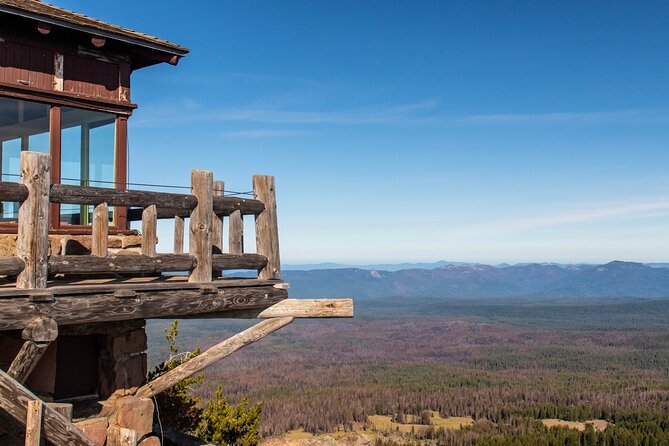
At Steel Information Center, you’re stepping into the park’s main visitor center. The building has history: it started as a ranger dormitory and later became the center, named for early park advocate William Gladstone Steel.
It also reopened to the public in 2024 after renovations intended to strengthen it for earthquakes and heavy snow. In other words, you’re getting a visitor hub that keeps the historic character while being built for real-world weather.
Plan on about 15 minutes. Use it for maps, context, and quick orientation before you head to the rim views.
Rim Village: The Center of Gravity for Lake Views and Quick Trails
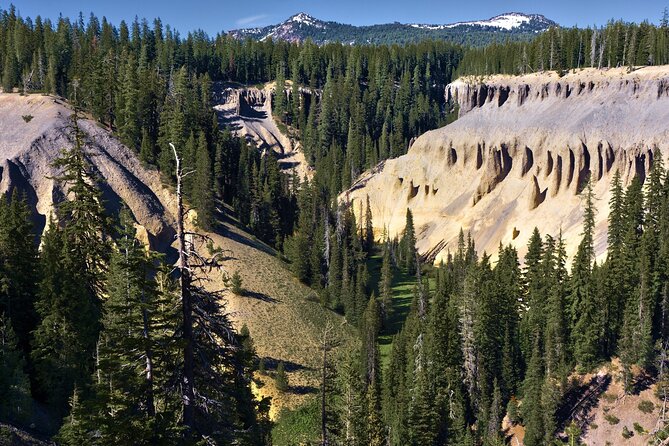
Now it’s time for the core hub: Rim Village Café and Gift Shop. This is where you get the big payoff views of Crater Lake and the nearby visitor services. You’ll also find Crater Lake Lodge nearby, plus a small visitor center and trail info.
Two trail options are highlighted from Rim Village:
- Discovery Point Trail: an easy 2-mile round trip along the rim, about 1 hour, with views toward Wizard Island
- Garfield Peak: a more challenging 3.5-mile round trip, for when you want a steeper payoff
Also, don’t skip the nearby Sinnott Overlook, which sits just below the visitor center and delivers dramatic cliffside views. This is one of those “short stop, big impact” moments—worth budgeting 15 minutes if you’re doing the center and overlooks in one block.
Crater Lake Lodge: Built in 1915, Still Feels Like the Main Event
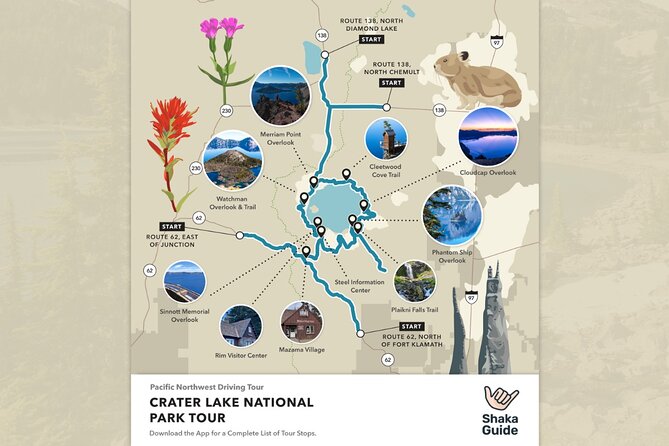
At Crater Lake Lodge, built in 1915, you’re close to the edge of the caldera with views over the lake and sub-alpine meadows. The lodge keeps the charm and character of its original style—stone and wood—so it feels less like a generic stop and more like a piece of park life.
This isn’t just scenery. If the dining room is open, I’d treat this as a break—either a meal or at least time on the veranda with coffee/food you can grab nearby. The stop is listed around 15 minutes, but it’s easy to stretch it if the weather is cooperating.
Rim Visitor Center and the Kiser Studio: Maps, Books, and a Passport Stamp
The tour also sends you to the Rim Visitor Center, located in the historic Kiser Studio in Rim Village. Here you can get park information, maps, books, and souvenirs. If you keep a Crater Lake passport, this is also where you can get it stamped.
Think of this as your “don’t get lost later” stop. It’s only about 5 minutes, but it can save you stress once you start making hike decisions.
Discovery Point Trailhead: Your Rim-to-Wizard Island Payoff Walk
Next is the Discovery Point Trailhead, the start of a 2-mile round trip rim walk to Discovery Point. The audio keeps the story running while you hike, and the trail’s purpose is simple: keep you close to the rim for sweeping Crater Lake views and a strong look at Wizard Island.
Budget about 1 hour. If your group has different hiking styles, this is one of the better options because it’s substantial enough to feel like a real outing, but not so long that it’s a marathon.
Sinnott Memorial Overlook: The Cliffside Exhibits Add a Personal Touch
From the rim visitor area, the tour highlights Sinnott Memorial Overlook. It’s behind the Rim Visitor Center and includes outdoor exhibits plus lake views.
This is a great stop for the part of your brain that wants meaning, not just beauty. Even a quick 5-minute visit can make the rest of the drive feel more grounded.
Watchman Overlook and Watchman Peak: Pick One View Style
At Watchman Overlook, you get an “unrivaled” view of Wizard Island and the crater from above. The tour notes this as a high-impact viewpoint with a nearby option to go up Watchman Peak.
Watchman Peak is a steeper, longer option: about 2 miles round trip to a historic fire lookout that sits over 8,000 feet above sea level, with panoramic views when you reach the top. The hike is about 1 hour in the tour pacing.
My advice: if your group loves views but hates big elevation gains, stick with the overlook. If you want the satisfaction of a summit-like destination (and you’re dressed for cooler temps at elevation), go for Watchman Peak.
Merriam Point and Steel Bay: Two More “Look Here” Moments
Then the tour keeps feeding you viewpoint after viewpoint:
- Merriam Point: a 5-minute stop with spectacular Crater Lake and Wizard Island views, plus distant Mount Scott in the mix. This point was named for John C. Merriam, tied to early nature interpretation work at Crater Lake.
- Steel Bay: near the Grouse Hill Picnic Area, with two scenic viewpoints. Steel Bay honors William Gladstone Steel, again tying the park’s geology to the people who fought to protect it.
These are quick, but they’re not filler. In a park with tons of “stop and stare” moments, multiple viewpoints help you see how the lake shifts with perspective.
Cleetwood Cove Trail: The Lake-Level Stop (And the Switchbacks)
The big hike moment in the middle of the drive is Cleetwood Cove Trail. It’s a 2-mile round trip hike with about 700 feet of elevation change, and the tour notes steep switchbacks—so treat it as real effort, not a casual stroll.
When you reach the lake, the tour points out that you can take a guided boat tour, with advance reservations recommended. There are also listed spots where you can get same-day tickets for the boat tour, if available.
You’ll likely want restrooms before you head out; the tour notes restrooms just across the road from the trailhead if you need to change clothes. Plan on about 1 hour for the hike portion alone.
One more thing: this is also the stop where you should be sure you understand swimming rules and fishing regulations, which are referenced in the visitor guide.
Skell Head, Cloudcap, and Phantom Ship: The “How Could This Be Real?” Cluster
Now you hit a sequence of stops where the audio explanation really earns its keep.
- Skell Head: a promontory viewpoint with a note about ancient spirits connected to the place (a cultural layer beyond geology). Expect about 5 minutes.
- Cloudcap Overlook: described as the highest paved road in Oregon, at roughly 8,000 feet elevation. This is where the audio flags whitebark pine flag trees, so you’ll know what to look for on the trees.
- Phantom Ship Overlook: one of the best places to see Phantom Ship Island. The tour describes the jagged volcanic rock rising over 170 feet above the lake surface and surviving Mount Mazama’s eruption. The misty effect is part of the drama—so slow down and let your eyes adjust.
These are all short stops—typically around 5 minutes each—but they make the day feel special because you’re getting the “wow” moments plus the why behind them.
Plaikni Falls and Pinnacles: Forest, Water, and Fossil Volcano Plumbing
Next up:
- Plaikni Falls Trailhead: a detour with an easy 2-mile round trip walk through old-growth forest and along a stream bank with summer wildflowers. At the end you reach a 20-foot waterfall. The tour calls out that the name Plaikni is Klamath for from the high country, tying it to where the water originates (near 7,000 feet).
- Pinnacles Overlook: an easy one-mile forested trail along the rim of Pinnacle Valley with views of the pinnacles.
The Pinnacles section includes a lot of useful geology. It explains that gray and brown pinnacles formed when pumice and ash filled the valley after Mazama’s eruption. It also describes heat and chemical action from volcanic gases and the formation of fumaroles—then how later erosion left behind “fossil fumaroles.”
This is one of the best places to pause and actually look closely at what your eyes are seeing. The audio gives you a mental model, so the towers don’t just look weird—they make sense.
Sun Notch, Vidae Falls, and Castle Crest Wildflower Trail: Finish with Easy Variety
To round out the loop, the tour includes more “short trail, big effect” choices:
- Sun Notch Trail: a loop a little under a mile long that winds through a meadow to the rim. It offers another view angle of Phantom Ship Island, and the time estimate is about 30 minutes.
- Vidae Falls: a roadside waterfall that’s easy for a quick photo stop (about 5 minutes).
- Castle Crest Wildflower Trail: a very manageable half-mile walk up to a meadow that can be full of wildflowers and butterflies if summer conditions are right. Plan on about 30 minutes.
This cluster is ideal for groups who don’t want a final steep climb but still want movement before you head back.
Price and Value: $15.19 Per Group, Not Per Person
At $15.19 per group (up to 15 people), this is one of the more budget-friendly ways to “guide” a whole vehicle. You’re not paying separately for each person to get the same narration—so your cost per head drops fast once you’re traveling with family or friends.
Here’s the value math that matters:
- Included: the audio narration, GPS turn-by-turn directions, an offline map, and the ability to start/pause/resume on your own schedule
- Not included: meals, entrance fees, and parking fees
- The tour ticket is a mobile ticket and the tour never expires, which is handy if you can’t fit Crater Lake into one perfect weather day
So budget for park entry and parking separately, then treat the tour fee as your “interpretation add-on.” If you like learning while you drive (and you’d rather spend the money on a picnic or boat tour than on a licensed guide), it’s a strong deal.
Who This Self-Guided Audio Tour Fits Best
This tour is a great fit if:
- you want hands-free guidance and stories that play automatically
- your group likes flexibility (walk now, skip later, come back another year)
- you’re traveling by car and you want a private experience for just your group
- you can handle some navigation prompts while you’re driving and parking
It’s less ideal if:
- you hate turn-by-turn instructions or prefer silence
- you’re counting on catching every single story point in a fixed order, especially if you face road closures and reroutes
- your group wants a chatty human guide who adapts on the fly
Should You Book This Crater Lake Audio Tour?
If you want to turn a long rim day into something more meaningful, I think you should book it. The offline audio + GPS timing is exactly the kind of tool that makes a self-drive feel intentional, not accidental. And the price per group is a bargain when you’re spreading it across a few people.
My last practical note: before you start, make sure you download the tour using solid Wi‑Fi so the offline experience actually works. Then build your day around a mix of rim overlooks and one or two hikes—Cleetwood Cove for the lake-level view, or Discovery Point/Watchman Peak for the big rim drama. That combo gives you the most “wow per hour.”
FAQ
What is the price for the Crater Lake National Park self-guided audio tour?
It costs $15.19 per group, with up to 15 people per group/vehicle.
How long does the Crater Lake audio tour take?
The duration is about 7 to 8 hours on average, depending on how many stops and hikes you choose.
What’s included in the tour?
You get hours of audio narration with stories and music, GPS turn-by-turn directions, an offline map (no Wi‑Fi or data needed), and the ability to explore at your own pace. The tour also never expires.
Do I need internet or cell service to use the tour?
No. The tour includes an offline map and works offline, so you don’t need continuous Wi‑Fi or data while you’re in the park.
Where does the tour start and end?
It starts at Fort Klamath, Oregon, and ends back at the meeting point.
Can I cancel and get a full refund?
Yes. You can cancel up to 24 hours in advance for a full refund. Cancellation less than 24 hours before the start time isn’t refundable.