REVIEW · SOUTH DAKOTA
Badlands National Park Self-Guided Audio Tour
Book on Viator →Operated by Shaka Guide Apps · Bookable on Viator
Badlands hits harder when you have your own pace. This self-guided audio tour threads together Cold War history, Lakota and homestead sites, and major Badlands viewpoints with GPS-triggered narration. I especially like that the audio plays automatically as you drive, plus the included offline map keeps you going even with zero signal. The one real drawback to keep in mind is that, as with any app-based tour, you’ll want to test your phone and download the tour before you start, because a few past users ran into app trouble.
You’re not stuck on a rigid bus schedule here. This is priced per group (up to 15 in one party), so it can feel like a bargain when you’re traveling with friends or family. You also get turn-by-turn directions, suggested speed, and a route that helps you hit the best overlooks without spending your whole day checking your phone.
In This Review
- Key moments that make this Badlands audio route worth it
- How the Shaka Guide drive tour really feels on the road
- Cold War start: Minuteman Missile National Historic Site
- Lakota life and early homesteading: Oglala Village + Prairie Homestead
- Badlands Wall classics: Big Badlands Overlook, The Door, and Window Trail
- Visitor Center orientation: Ben Reifel, fossils, and getting your bearings
- Overlooks with names and meaning: Bigfoot Pass, Ancient Hunters, Pinnacles
- Hikes and ladder moments: Notch Trail and the more serious routes
- Short walks with big payoffs: Cliff Shelf Nature Trail
- Prairie edges and far overlooks: Prairie Wind, Burns Basin, Homestead, Yellow Mounds
- Conata Picnic Area and the farther Badlands: quieter breaks and road options
- A silly-but-worth-it detour: Wall Drug Store
- Price, time, and value: when $12.79 per group makes sense
- Best fit for who: families, history fans, and self-guided pros
- Should you book this Badlands National Park self-guided audio tour?
- FAQ
- How much does the Badlands National Park self-guided audio tour cost?
- What’s the approximate duration?
- Do you need Wi-Fi or cell service while using the tour?
- Does the audio play automatically while driving?
- Is this a per-person tour or per-vehicle?
- Where does the tour start?
- Are entrance fees included?
- Is the Delta-01 Launch Control Facility included?
- Can I customize which stops I do?
- Is cancellation allowed after booking?
Key moments that make this Badlands audio route worth it
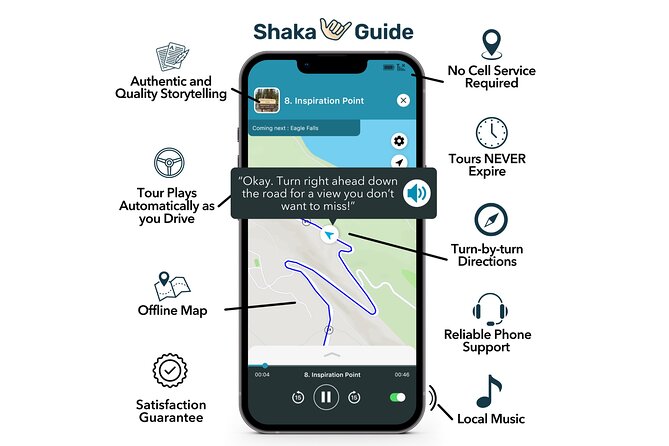
- GPS-activated stories and music that play as you drive, hands-free
- Offline map access so you’re not hunting for cell service
- One group price (up to 15) instead of per-person ticketing
- A smart mix of views and context: geology, fossils, and human history
- Wheelchair-friendly routes at several Badlands Wall and visitor areas
- Flexible start options (Kadoka, Conata, Interior) plus a customizable start time
How the Shaka Guide drive tour really feels on the road
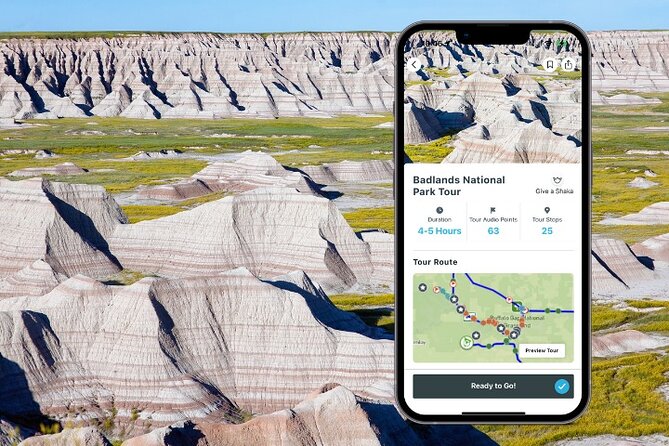
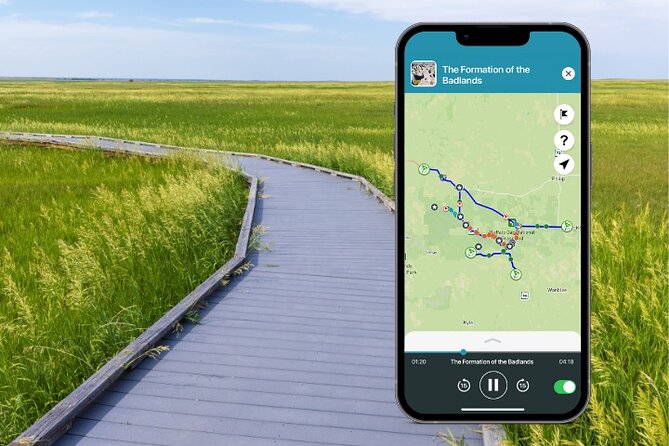
This is a mobile-ticket self-guided tour built for one vehicle. Your phone becomes your co-pilot: GPS triggers the audio and directions, and you can pause, resume, and stop when you want. The tour start is customizable, and you can begin from Wasta, SD or optional starting points in Kadoka, Conata, or Interior.
The biggest practical win is time. Badlands has lots of short turnoffs and overlooks, and it’s easy to waste time figuring out what to see next. With this setup, you get turn-by-turn guidance and audio that tells you what you’re looking at while you’re still parked and ready to take it in.
One more detail that matters: the tour includes an offline map. That’s not a small thing in rural South Dakota. Download ahead when you can, and keep your phone charged—your battery is the one thing you can’t narrate through.
You can also read our reviews of more tours and experiences in South Dakota.

Cold War start: Minuteman Missile National Historic Site
Your day opens in Cold War territory at Minuteman Missile National Historic Site. Expect a decommissioned launch facility and a missile silo experience designed to explain what these systems meant for national security and human risk.
Here’s what you’re guided to look for:
- The Launch Control Facility, an underground bunker-style space where missile crews could have fired Minuteman II missiles.
- A real missile experience at the Delta-09 silo area, which hits differently in person than it does in photos.
Most of this stop is treated as free within the tour flow. But there’s an important add-on you should plan for: the Delta-01 Launch Control Facility is listed as a separate paid ticket (priced per adult and child). If Cold War history is your focus, you’ll want to budget for that extra ticket so you don’t feel stuck deciding on the spot.
Why this stop works in a self-guided format: the audio helps you understand what you’re seeing before you walk deeper into the facility areas. It turns a quick roadside stop into something more meaningful without forcing you into a fixed timed tour.
Lakota life and early homesteading: Oglala Village + Prairie Homestead
After the missile sites, the route pivots toward lived experience. You’ll spend time at the Oglala Lakota Living History Village, an open-air living history stop focused on how the Oglala people adapted their homes on the Pine Ridge Reservation.
What I like about this kind of stop in a drive tour: it’s flexible. You can linger at craft demonstrations and residential recreations at your own pace without worrying about catching a bus window. In your guided time, you’re set up to see traditional arts like hide tanning and beadwork, explained by local Lakota guides.
Next comes Prairie Homestead Historic Site, built around the preserved 1909 sod house constructed by Ed and Alice Brown. This is the “how did people actually survive here?” chapter. You walk through their dugout-style home and outbuildings and get an idea of the grit behind homesteading in South Dakota.
Two practical notes:
- This portion is not included by admission in the way the overlooks are, so plan for time and any on-site costs that come with the sites themselves.
- If you’re traveling with kids, this is a nice contrast stop: animals, old structures, and period clothing can make the history feel less abstract.
Badlands Wall classics: Big Badlands Overlook, The Door, and Window Trail
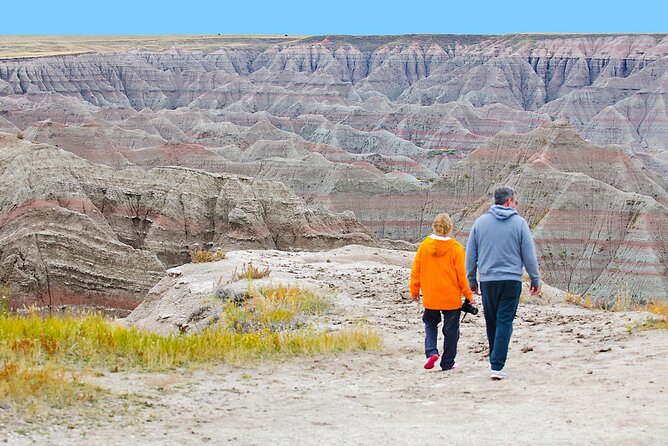
Now you get to the main event: Badlands viewpoints that make you stop talking and start photographing.
You’ll hit Big Badlands Overlook first, guided to an accessible short trail and viewing platform. This is a great starter view: layers of eroded rock stretch into the distance, and the eastern wall called the Wall dominates the scenery, with reddish hues tied to the Brule Formation.
From there, the route guides you to two key “Badlands Wall” experiences built around boardwalks:
- A wheelchair-accessible boardwalk that takes you to the passage nicknamed The Door. It’s a quarter-mile journey through a natural opening that frames a big vista.
- Window Trail, another short fully accessible path with a quarter-mile boardwalk. You end up at the natural opening called the Window, where the Badlands Wall creates a framed view of layered canyons.
I love this part of the tour because it gives you high-impact views with low logistical stress. Even if you later do tougher hikes, you’ll still collect major photos and big “wow” moments without needing to time footwear, ladders, or knee-friendly terrain yet.
If you’re traveling with mixed mobility, these stops are also your anchor. They help you keep everyone in the car engaged—less driving in circles, more shared viewing.
Visitor Center orientation: Ben Reifel, fossils, and getting your bearings
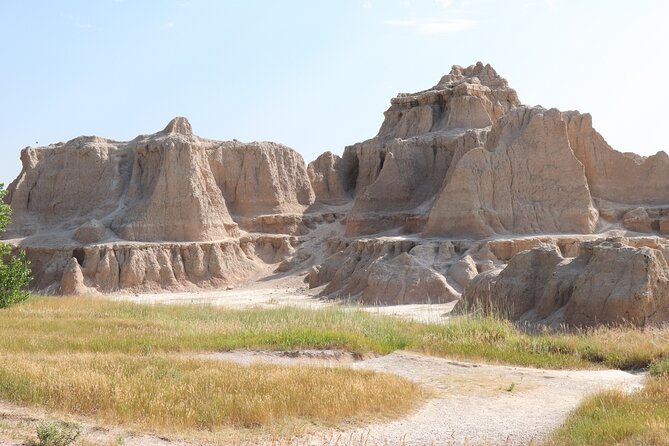
You’ll reach Ben Reifel Visitor Center, the main hub for Badlands National Park. This is where you can reset your brain. The exhibits cover geology, fossils, and cultural history, and you’ll also have the chance to watch the park film and talk with rangers for planning tips.
This is also one of the most practical times in the day to use indoor time:
- Restrooms are available.
- You can warm up or cool down depending on weather.
- You can sanity-check your next hike plans before committing to longer trail sections.
Then you’ll follow the Fossil Exhibit Trail, which is an accessible boardwalk loop with replicas and educational displays. The goal isn’t fossil hunting; it’s learning. You’ll get a feel for geologic time and the kind of paleontology the park is famous for, including references to creatures like saber-toothed cats and giant mammals through the exhibit materials.
Why this matters: Badlands looks like chaos from the road. These stops help you start seeing the order—layering, time, and how erosion shaped what you see now.
Overlooks with names and meaning: Bigfoot Pass, Ancient Hunters, Pinnacles
Badlands isn’t just rocks. The route also points you to human stories layered into the area.
At Bigfoot Pass Overlook, the audio frames the view with history: it commemorates Chief Spotted Elk (Bigfoot) and his Lakota band using this route while fleeing U.S. troops in 1890. You’re looking at the same worn terrain the audio places in a human context, which makes the view feel less random.
Then you’ll reach Ancient Hunters Overlook, where the story is prehistoric. You get information about ancient bison hunters who drove herds over an edge millions of years ago. The geologic slump area has slightly different conditions, which the spot uses to connect you to the land’s changing patterns over time.
Finally, it’s time for a top-of-park moment: Pinnacles Overlook. It’s the highest point in Badlands National Park and gives you a panoramic vista aimed outward toward the distant Black Hills. The stop also asks you to keep an eye out for bighorn sheep grazing on slopes if you’re lucky.
These overlooks are where the tour shines for first-timers. You don’t just see a view; you get a reason to look harder—at a feature’s origin, at the scale, or at a story anchored to the place.
Hikes and ladder moments: Notch Trail and the more serious routes
Some Badlands stops are easy to enjoy. Some are made for people who like a challenge.
Notch Trail is your big hike set piece: about 1.5 miles round-trip, with uneven terrain and a wooden ladder section that adds a little adrenaline. You’ll cross a canyon and reach the Notch viewpoint overlooking the White River Valley. This is listed as moderately challenging, and the audio helps set expectations before you commit.
Here’s the key “do I want this?” checklist:
- If your ankles dislike uneven terrain, take it slow.
- If ladders stress you out, skip it and stick with the boardwalk trails.
- If you love big payoffs, this is one of the best reward-to-effort hikes on the route.
You’ll also see hike options that are more about distance than technical climbing:
- A ~5-mile hike described as point-to-point through prairies and rock formations nicknamed castles, noted as relatively flat, with the reminder to plan your return.
- An unmarked path starting at Conata Picnic Area described as about 3 miles, with rolling plains and no maintained marking. You’ll want a sense of direction and comfort with informal trail conditions.
And for true backcountry types, the route includes advanced options like:
- Sage Creek Loop at 20+ miles, unmarked and in wilderness areas, with uneven ground, possible mud, limited water access, and the clear warning that it’s for experienced backpackers with navigation skills and supplies.
I appreciate that the tour doesn’t oversell these. It tells you what kind of physical commitment is involved. That’s how you keep a self-guided tour from turning into an unexpected workout problem.
Short walks with big payoffs: Cliff Shelf Nature Trail
Not every hike needs to be long to feel worth it.
Cliff Shelf Nature Trail is a short 0.5-mile loop built around boardwalks and a few stairs, ending at a viewing platform. You get broad vistas over Badlands and a change of pace through a juniper forest area, which contrasts with the harsher rock terrain you’ll see elsewhere.
This stop is ideal when you want the Badlands look without burning hours. It’s also a good “stretch your legs” choice if your earlier viewpoints were all stop-and-go photo breaks.
Prairie edges and far overlooks: Prairie Wind, Burns Basin, Homestead, Yellow Mounds
As the day moves on, the route expands beyond spires into prairie and rolling view territory.
- Prairie Wind Overlook uses a short boardwalk to reach a viewing platform over mixed-grass prairie habitat. The idea here is a calmer pace: native grasses and wide open sightlines, with wildlife opportunities connected to the ecosystem.
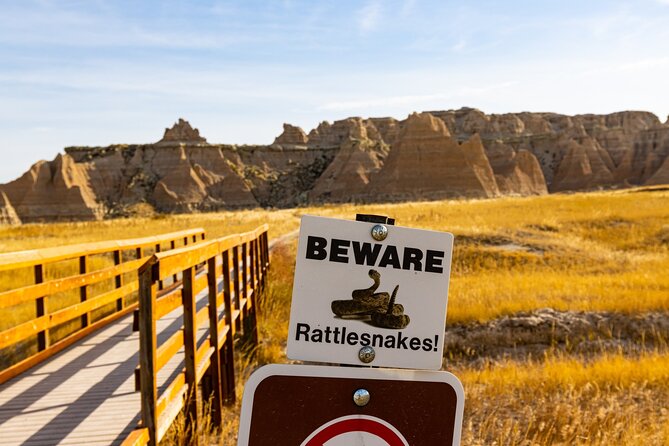
- Burns Basin Overlook adds another layer: a basin view with a historical name tied to sheepherder Wilson Burns. You’re also pointed toward wildlife possibilities like rattlesnakes, bison, and birds of prey.
- Homestead Overlook flips the composition: you see the maze of eroded rock formations up close, then a wide green prairie expanse beyond. It connects the park’s natural hardness with the human effort to tame it.
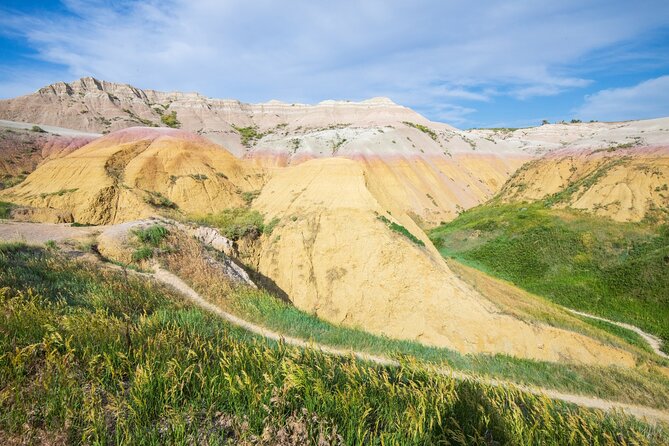
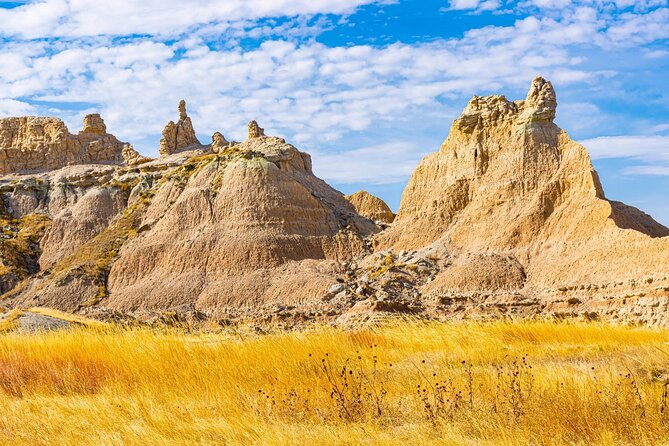
- Yellow Mounds Overlook stands out for geology. Instead of the more common reddish Badlands tones, this stop emphasizes yellow, orange, and beige layers linked to ancient seas and decaying plant material.
I like these stops because they keep the day from feeling repetitive. You’re still in Badlands, but you’re seeing different processes—water, time, erosion—and different kinds of habitat.
Conata Picnic Area and the farther Badlands: quieter breaks and road options
Conata Picnic Area is the route’s built-in breather. It’s a remote rest stop near the wilderness area, with covered picnic tables and vault toilets. There’s no potable water listed, so bring what you’ll need if you’re planning to linger.
From there, you can extend your visit via nearby routes, including the unmarked path described earlier. It’s also a good location if you want the feel of being away from the main crowd flow—without requiring full wilderness commitments.
The tour also includes a Sage Creek Road option: an unpaved 12-mile scenic route with multiple overlooks. This is less about sharp spires and more about rolling hills and wildlife watching, with possibilities like bison, pronghorn antelope, bighorn sheep, and prairie dogs.
One practical thought: unpaved roads can be slow. If you’re prone to rushing when you travel, give yourself extra time here so you don’t feel late for sunset.
A silly-but-worth-it detour: Wall Drug Store
No South Dakota road trip feels complete without at least one roadside legend, and Wall Drug Store earns its place. The route calls it a cowboy-themed labyrinth of souvenirs, snacks, pharmacy services, and restaurants. It’s famous for its playful signage about free ice water miles away, plus the iconic giant brontosaurus photo stop.
This is a practical break too: you can refuel, stretch, and reset before you head back toward Badlands overlooks.
Price, time, and value: when $12.79 per group makes sense
The tour is $12.79 per group, up to 15 people, and it’s designed for a single vehicle. That pricing model can be a smart move if you’re traveling with a few people who want the same route but don’t want to buy separate tickets.
You also get a lot of guided content: narration with stories, travel tips, and music, plus GPS turn-by-turn directions and an offline map. The tour duration is listed at roughly 11 to 12 hours, which helps explain why it’s booked about a week in advance on average.
So when does it feel like value?
- If your group is large enough that per-person pricing would add up.
- If you plan to stop repeatedly for photos and trail sections.
- If you want context for what you’re seeing without paying for multiple guided tours.
When it might feel less perfect:
- If your group wants only a few quick overlooks and you’re sure you won’t use the audio stops much.
- If you dislike app-based navigation or worry your phone battery won’t last.
Best fit for who: families, history fans, and self-guided pros
This is a strong choice if you:
- Like driving your own schedule, with less pressure than a guided bus tour.
- Want history woven into the scenery (Cold War to Lakota to homesteading).
- Appreciate both short accessible boardwalks and longer hiking options.
- Travel with mixed interests, since the route includes fossils, geology, and human stories.
If you’re a careful planner, it also helps. Download your tour first, charge up, and plan for a full day. Badlands is big, and your time will vanish if you try to “just do it fast.”
Should you book this Badlands National Park self-guided audio tour?
Yes, if you want Badlands with context and you like choosing your own pace. The GPS-triggered audio and offline map are exactly what make this easy for a long day of stops, and the route covers the must-see viewpoints plus the history stops that most people accidentally skip.
I’d only hesitate if you rely on flawless app tech with no backup. The tour is generally praised for its narration and music quality, but a smaller number of users reported redeem-code and audio playback problems serious enough to ruin their first attempt. Your best move is simple: test the app and download ahead of time before you roll out.
FAQ
How much does the Badlands National Park self-guided audio tour cost?
It costs $12.79 per group (up to 15 people).
What’s the approximate duration?
Plan for about 11 to 12 hours.
Do you need Wi-Fi or cell service while using the tour?
No. The tour includes an offline map, and you can download the tour ahead of time using strong Wi-Fi.
Does the audio play automatically while driving?
Yes. Audio narration plays automatically as you drive using GPS activation.
Is this a per-person tour or per-vehicle?
It’s priced per group for the entire vehicle, not per person.
Where does the tour start?
It starts at Wasta, SD 57791. Optional starting points are also available in Kadoka, SD; Conata, SD; and Interior, SD.
Are entrance fees included?
No. Entrance fees are not included, and parking fees are also not included.
Is the Delta-01 Launch Control Facility included?
No. Delta-01 is listed as an additional ticket with separate pricing, while the rest of the Minuteman areas in the route are treated as free within the tour flow.
Can I customize which stops I do?
Yes. You can pick stops and skip ones you don’t want.
Is cancellation allowed after booking?
Free cancellation is available up to 24 hours in advance for a full refund. If you cancel less than 24 hours before the start time, it isn’t refunded.